
Your back is one of the largest muscle groups in your body. It drives pulling strength, protects your spine, and shapes the V-taper physique most lifters are chasing. But training it well takes more than randomly picking machines and doing a few sets. You need the right exercises, the right intent, and a clear understanding of what each movement actually does.
This guide covers the best back exercises at the gym, broken down by muscle target, form cues, and how to program them for width versus thickness. Whether you are a beginner building your first routine or an experienced lifter fixing weak points, this is your complete reference.
Key Takeaways
- Width comes from vertical pulling — exercises like pull-ups and lat pulldowns develop the latissimus dorsi to create that wide, tapered look.
- Thickness comes from horizontal pulling — barbell rows, cable rows, and chest-supported rows build the mid-back, traps, and rhomboids.
- Form cues matter more than load — pulling with your elbows (not your hands) activates the lats far more effectively than gripping harder or using heavier weight.
- Face pulls are underrated — this cable exercise targets the rear deltoids and rotator cuff, which are critical for shoulder health and posture.
- Programming needs both planes — a complete back training session includes at least one vertical pull and one horizontal pull per workout.
- Frequency beats volume in isolation — training back twice per week consistently outperforms one high-volume session per week.
What Muscles Make Up the Back?

Quick Answer: The back includes the latissimus dorsi, trapezius, rhomboids, rear deltoids, teres major, and erector spinae. Each muscle has a different role in pulling, stabilizing, and extending the spine. Training all of them requires vertical and horizontal pulling movements.
Understanding what you are training helps you choose exercises with purpose. The back is not one muscle. It is a system of overlapping muscles that work together during pulling and rowing movements.
Primary Back Muscles and Their Functions
The latissimus dorsi (lats) is the largest back muscle. It runs from your lower spine to your upper arm bone. When trained, it creates the wide, flared appearance visible from behind. The lats are the primary mover in all vertical pulling movements like pull-ups and lat pulldowns.
The trapezius covers the upper and mid-back. The upper traps elevate the shoulders. The mid and lower traps pull the shoulder blades together and down. Rows and shrugs train the traps effectively.
The rhomboids sit between the shoulder blades. Their job is scapular retraction, pulling your shoulder blades together. Horizontal pulling exercises like cable rows and barbell rows hit the rhomboids hard when you squeeze at the end of each rep.
The rear deltoids are technically shoulder muscles, but they assist with horizontal pulling and are often undertrained. Face pulls and reverse flyes isolate them directly.
The erector spinae run along your spine from your lower back to your neck. They are the primary stabilizers during deadlifts, barbell rows, and any loaded hip hinge movement.
| Muscle | Primary Function | Best Exercise Type | Fiber Composition | Common Weakness Sign |
|---|---|---|---|---|
| Latissimus Dorsi | Shoulder adduction and extension | Vertical pull (pull-up, lat pulldown) | ~50% Type I, ~50% Type II | Narrow back, poor V-taper |
| Trapezius (Mid/Lower) | Scapular retraction and depression | Horizontal row, face pull | ~55% Type I | Rounded shoulders, poor posture |
| Rhomboids | Scapular retraction | Horizontal row with squeeze | ~55% Type I | Forward shoulder tilt |
| Rear Deltoids | Horizontal shoulder extension | Face pull, reverse flye | ~50% Type I, ~50% Type II | Imbalanced pressing strength |
| Erector Spinae | Spinal extension and stabilization | Deadlift, good morning | ~65% Type I | Lower back fatigue, poor posture |
What Is the Difference Between Back Width and Back Thickness?
Quick Answer: Back width is built by vertical pulls that develop the lats and create a wide silhouette when viewed from the front. Back thickness is built by horizontal rows that develop the mid-back, traps, and rhomboids for a dense, muscular look from the side.
Most lifters train one without the other. The result is either a wide but flat back, or a thick but narrow one. You need both movement patterns to build a complete, balanced back.
Width Training: The Vertical Pull Pattern
Vertical pulls involve pulling weight from above your head down toward your torso. This motion stretches and contracts the lats through a long range of motion. Pull-ups, lat pulldowns, and straight-arm pulldowns all fall into this category.
The key is driving your elbows toward your hips, not just bending your arms. Think of your hands as hooks. Pull with your elbows. That mental cue shifts work from your biceps to your lats.
Thickness Training: The Horizontal Pull Pattern
Horizontal pulls involve pulling weight toward your torso from in front of you. Barbell rows, cable rows, dumbbell rows, and chest-supported rows all use this pattern. They load the mid-back muscles through a different angle than vertical pulls can reach.
At the end of each row, squeeze your shoulder blades together. That final contraction activates the rhomboids and mid-traps in a way that the lat-dominant vertical pull simply cannot replicate.
What Are the Best Exercises for Back Width?
Quick Answer: The best exercises for back width are pull-ups, lat pulldowns, and single-arm dumbbell rows. These vertical and long-axis pulling movements stretch the lats fully and allow progressive overload over time. Aim for 3-4 sets of 8-12 reps per session.
Pull-Up
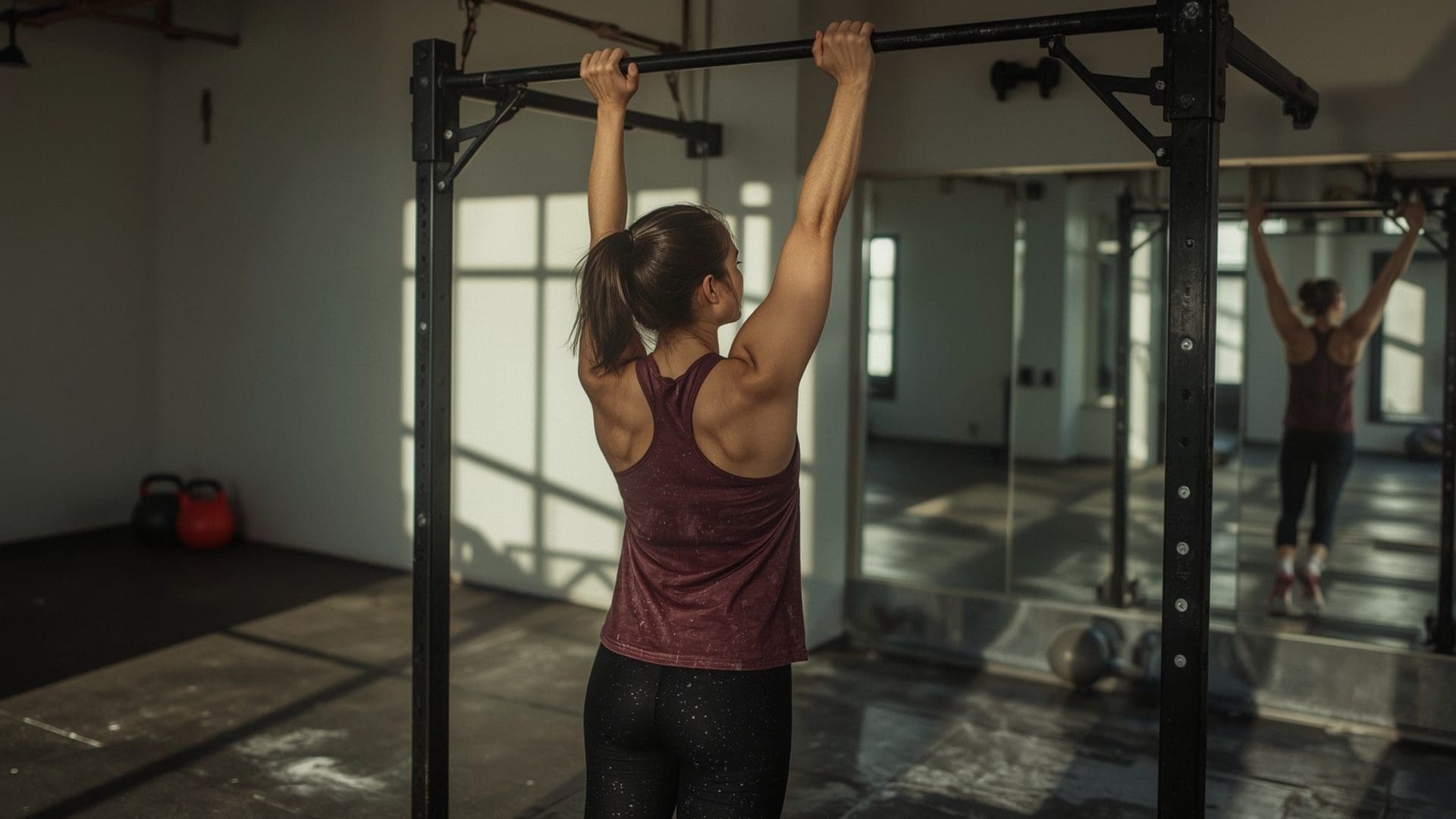
The pull-up is the single best bodyweight exercise for back width. You grip a bar with your palms facing away, slightly wider than shoulder-width. From a dead hang, you pull your chest toward the bar by driving your elbows straight down.
Do not shrug your shoulders at the top. Do not kip or swing. A slow, controlled pull-up with full range of motion builds more muscle than twice the reps done sloppily.
If you cannot yet do a full pull-up, use a band-assisted pull-up or lat pulldown to build the required strength. The goal is not to look strong. The goal is to build strength.
Lat Pulldown
The lat pulldown machine lets you use a wide range of loads, making it perfect for beginners and advanced lifters alike. Sit with your thighs locked under the knee pad. Grip the bar just outside shoulder-width. Lean back slightly (around 15 degrees) to create a straight pulling angle to your upper chest.
Pull the bar down to your collarbone level, then slowly let it return to the start. The slow return (the eccentric phase) is where a lot of the muscle building happens. Do not rush it.
Straight-Arm Pulldown
This cable exercise is a lat isolation movement. Stand in front of a cable machine with a rope or bar attachment set at the top pulley. With arms nearly straight and a slight bend at the elbows, pull the cable down toward your thighs in an arc motion.
This exercise removes the biceps from the movement entirely. It is an excellent way to pre-exhaust the lats before compound pulling exercises, or to finish a back session with a high-rep pump set.
What Are the Best Exercises for Back Thickness?

Quick Answer: The best exercises for back thickness are barbell rows, seated cable rows, and chest-supported dumbbell rows. These horizontal pulling movements load the mid-back, traps, and rhomboids through direct angles. Program 3-4 sets of 6-12 reps per session.
Barbell Row
The barbell row is a compound lift that trains the entire back system under heavy load. Stand with a hip-width stance and hinge at the hips until your torso is roughly 45 degrees to the floor. Grip the barbell just outside your knees. Pull the bar toward your lower chest or upper stomach, squeezing your shoulder blades together at the top.
The most common mistake is using too much momentum. A slight body swing at the start of each rep is acceptable. Violent hip thrusting on every rep means the load is too heavy and your back is getting almost none of the work.
Use a double overhand grip when possible. Switch to a mixed grip (one palm up, one palm down) only when grip becomes the limiting factor.
Seated Cable Row
The seated cable row provides constant tension throughout the full range of motion. This is something free weights cannot match. The cable pulls against you on the way back, which means your lats and mid-back are working even as you reach forward at the start of each rep.
Sit tall. Do not round your lower back to reach further. That extra range of motion is not coming from your back, it is coming from your spine. Reach forward by letting your shoulder blades protract, then row back by retracting them fully.
Chest-Supported Dumbbell Row
Set an adjustable bench to 30-45 degrees. Lie face down on it with a dumbbell in each hand. Row the dumbbells toward your hips, keeping your elbows close to your body. Because your chest is supported, you cannot cheat with your lower back or momentum.
This is one of the most honest back exercises you can do. Every rep isolates the mid-back muscles because there is no way to cheat the movement. It is also joint-friendly, making it a smart choice for lifters managing lower back soreness.
Why Should You Include the Face Pull in Every Back Workout?
Quick Answer: Face pulls target the rear deltoids and rotator cuff muscles that most lifters neglect. These muscles stabilize the shoulder joint and counteract the internal rotation caused by heavy bench pressing and overhead pressing. Include 2-3 sets of 15-20 reps every back session.
Most gym-goers think the face pull is a minor accessory move. It is not. The rear deltoids and rotator cuff muscles protect the shoulder joint from injury. When they are weak, pressing movements become dangerous over time. Lower back pain, shoulder impingement, and poor posture all have roots in underdeveloped posterior shoulder muscles.
How to Do the Face Pull Correctly
Set a cable machine pulley to face height. Use a rope attachment. Stand back far enough to have tension on the cable from the starting position. Pull the rope toward your face, separating your hands as you do, finishing with your elbows flared wide and your fists beside your ears.
This movement is not about load. Heavy face pulls turn into rear delt rows and lose their target. Keep the weight light enough to feel the rear delts and upper traps doing the work. Higher reps (15-25) work best here.
How Should You Structure a Complete Back Workout at the Gym?
Quick Answer: A complete back workout includes one vertical pull, one horizontal row, one isolation or accessory exercise, and one rear delt movement. Order exercises from heaviest compound to lightest isolation. Training back twice per week gives better results than one long session.
Sample Back Workout A: Width Focus
- Pull-Up — 4 sets × 6-10 reps (weighted if needed)
- Lat Pulldown — 3 sets × 10-12 reps
- Seated Cable Row — 3 sets × 10-12 reps
- Straight-Arm Pulldown — 3 sets × 12-15 reps
- Face Pull — 3 sets × 15-20 reps
Sample Back Workout B: Thickness Focus
- Barbell Row — 4 sets × 5-8 reps
- Chest-Supported Dumbbell Row — 3 sets × 10-12 reps
- Lat Pulldown — 3 sets × 10-12 reps
- Single-Arm Cable Row — 3 sets × 12 reps per side
- Face Pull — 3 sets × 15-20 reps
Programming Parameters for Back Training
| Exercise | Sets | Rep Range | Rest Period | Load (% of 1RM) | Weekly Frequency |
|---|---|---|---|---|---|
| Pull-Up | 3-5 | 5-12 | 90-180 sec | 75-85% | 2x per week |
| Lat Pulldown | 3-4 | 8-15 | 60-120 sec | 65-80% | 2x per week |
| Barbell Row | 3-5 | 4-8 | 120-180 sec | 75-85% | 1-2x per week |
| Seated Cable Row | 3-4 | 10-15 | 60-90 sec | 65-75% | 1-2x per week |
| Face Pull | 2-4 | 15-25 | 30-60 sec | 40-60% | 2-3x per week |
| Straight-Arm Pulldown | 2-3 | 12-20 | 45-60 sec | 40-60% | 1-2x per week |
Which Back Exercise Should Beginners Start With?
Quick Answer: Beginners should start with the lat pulldown and seated cable row. These machines provide stability and allow you to learn pulling mechanics safely. Once you can lat pulldown your bodyweight, you are ready to attempt pull-ups and barbell rows.
Machines are not a shortcut or a lesser option. They are a tool that lets you focus entirely on the movement pattern without worrying about balance or load management. Building strong movement patterns first prevents bad habits that are hard to fix later.
After 4-8 weeks on machines, beginners can transition to free weight rows and assisted pull-ups. Progress is about building a foundation, not rushing to the hardest variation.
How Do Grip Variations Change Which Muscles You Target?
Quick Answer: Grip width and orientation shift which muscles do the most work during back exercises. Wide grips emphasize the outer lats. Close underhand grips shift load to the lower lats and biceps. Neutral grips allow maximum load with less joint stress across most pulling movements.
Grip Type Comparison for Pulling Exercises
| Grip Type | Hand Orientation | Primary Muscle Emphasis | Best For | Caution |
|---|---|---|---|---|
| Wide Overhand | Palms away, outside shoulder-width | Outer lats, teres major | Lat width, pull-ups | Reduces range of motion |
| Shoulder-Width Overhand | Palms away, shoulder-width | Full lat, mid-back | General lat pulldown, barbell row | None significant |
| Close Underhand (Supinated) | Palms toward you, narrow | Lower lats, biceps | Chin-up, underhand pulldown | Higher bicep stress |
| Neutral (Parallel) | Palms facing each other | Lower lats, brachialis | Cable rows, neutral-grip pulldown | None significant |
What Common Mistakes Kill Back Gains at the Gym?
Quick Answer: The most common back training mistakes are pulling with the arms instead of the elbows, using too much momentum on rows, skipping the full stretch at the bottom, and neglecting rear delts and face pulls. Each mistake reduces lat activation and increases injury risk.
Mistake 1: Pulling With Your Hands Instead of Your Elbows
When you think about pulling weight with your hands, your biceps take over. Your lats barely activate. Instead, imagine your hands are hooks attached to a rope. The elbows are what move. Drive the elbows down and back. The hands just hold on.
This mental shift, called the mind-muscle connection, can increase lat activation significantly on every rep without changing the weight, the machine, or the exercise.
Mistake 2: Skipping the Bottom Stretch
The stretched position at the bottom of a lat pulldown or cable row is where the lat is under the most tension. Many lifters cut this short by not fully extending at the top. A full range of motion, from full stretch to full contraction, produces more muscle growth than partial reps at any load.
Mistake 3: Training Back Only Once Per Week
The back is a large muscle group with high recovery capacity. Training it once per week leaves muscle-building stimulus on the table. Research consistently supports training major muscle groups at least twice per week for better hypertrophy (muscle growth) outcomes. Split your volume across two sessions rather than loading everything into one long workout.
Mistake 4: Never Changing the Grip or Angle
Doing the same grip, the same machine, and the same cable angle every session trains the same muscle fibers repeatedly. Rotating grip width, attachment type, and cable angle every few weeks ensures you are hitting all parts of the lat and mid-back, not just the parts your default setup targets.
How Do You Progress on Back Exercises Over Time?
Quick Answer: Progress on back exercises by adding weight or reps each week (progressive overload), tracking each session, and using double progression: add reps until you hit the top of your rep range, then increase load by the smallest available increment and build back up.
Progressive Overload for Back Training
Progressive overload means your muscles face a slightly greater challenge each session. For back exercises, this can mean adding 2.5 kg to your barbell row, doing one more pull-up per set, or slowing the eccentric (lowering) phase to increase tension duration.
Tracking your sessions is non-negotiable if you want to progress. If you do not write down what you lifted last week, you have no baseline to beat this week. A simple notebook or a free app works perfectly.
| Exercise | Beginner | Intermediate | Advanced | Metric Used |
|---|---|---|---|---|
| Pull-Up | 1-3 reps bodyweight | 8-12 reps bodyweight | 5 reps + 20 kg added | Clean reps, full range |
| Lat Pulldown | 50% bodyweight × 10 | 75% bodyweight × 10 | 100% bodyweight × 10 | Load relative to bodyweight |
| Barbell Row | 50 kg × 8 | 80 kg × 8 | 120 kg × 8 | Absolute load (kg), controlled form |
| Seated Cable Row | 40 kg × 12 | 70 kg × 12 | 100 kg × 12 | Absolute load (kg), controlled form |
Frequently Asked Questions
How many back exercises should I do per workout?
Three to five exercises per back session is enough for most lifters. Include one vertical pull, one horizontal row, and one or two accessory movements. More exercises do not automatically mean better results. Quality of effort and progressive overload matter more than exercise variety.
Is the deadlift a back exercise?
The deadlift is primarily a hip hinge and posterior chain movement. It trains the erector spinae heavily as stabilizers, along with the glutes and hamstrings as primary movers. It is not a substitute for direct lat and mid-back training. Use it as a foundational strength movement, not your only back exercise.
How long does it take to build a wider back?
Noticeable lat width development typically takes 3-6 months of consistent training. Visible changes in back shape and depth take 6-12 months for most natural lifters. Genetics influence where and how fast your back responds, but the two biggest factors are consistent training and progressive overload over time.
Should I use straps for back exercises?
Lifting straps are useful when grip fatigue limits your back training before your back muscles are fully worked. Use them on heavier rows and lat pulldowns when grip fails first. Do not use straps on every set, since grip strength itself is worth developing separately through exercises like farmer carries or dead hangs.
Can I train back and biceps on the same day?
Yes, and it is one of the most popular training splits for good reason. Back exercises already recruit the biceps as secondary movers. Training biceps immediately after back takes advantage of that pre-activation and keeps the session efficient. Finish your compound back exercises first, then move to bicep isolation work.
What is scapular retraction and why does it matter for rows?
Scapular retraction is the movement of pulling your shoulder blades together toward your spine. In all horizontal row movements, full retraction at the end of each rep maximally contracts the rhomboids and mid-trapezius. Without it, rows become primarily a bicep exercise with minimal mid-back activation.