
Your upper body carries you through nearly every physical task you do. Pushing a heavy door open, lifting groceries overhead, even maintaining good posture at your desk all depend on the muscles from your waist up. A well-structured upper body workout at the gym targets your chest, back, shoulders, and arms in a way that builds real strength, visible muscle, and functional durability.
This guide breaks down the exercises, programming variables, and weekly structure you need. Whether you’re a beginner learning the foundational lifts or an intermediate lifter ready to push past a plateau, you’ll find actionable routines built around proven principles. No fluff. Just the biomechanics, the numbers, and the execution.
Key Takeaways
- Target all four major muscle groups — your chest, back, shoulders, and arms each need direct work for balanced upper body development.
- Compound exercises build the foundation — the bench press, overhead press, barbell row, and pull-up should anchor every upper body session.
- Volume and intensity matter more than exercise variety — 10 to 20 working sets per muscle group per week, performed at the right intensity, drives growth.
- Progressive overload is non-negotiable — you must increase weight, reps, or sets over time to keep making gains.
- Rest periods affect your results — 2 to 3 minutes between heavy compound sets and 60 to 90 seconds between isolation moves.
- Two upper body sessions per week is the minimum — hitting each muscle group twice weekly produces significantly more growth than once-a-week training.
What Muscles Make Up the Upper Body?
Quick Answer: The upper body includes your chest (pectoralis major and minor), back (latissimus dorsi, trapezius, rhomboids, erector spinae), shoulders (anterior, lateral, and posterior deltoids), and arms (biceps brachii, triceps brachii, and forearms). Each group needs targeted work for balanced development.
Understanding muscle anatomy helps you choose the right exercises and spot imbalances. Most gym goers overtrain the “mirror muscles” (chest and biceps) and neglect the back and rear delts. This creates rounded shoulders and increases injury risk.
Chest Muscles
Your pectoralis major is a large, fan-shaped muscle covering most of your chest. It has two heads: the clavicular head (upper chest) and the sternal head (mid and lower chest). The pectoralis minor sits underneath and stabilizes your shoulder blade. Pressing and fly movements target these muscles.
Back Muscles
Your back is a complex network. The latissimus dorsi (lats) create that wide V-taper look. The trapezius runs from your neck to your mid-back and handles shrugging and scapular retraction. The rhomboids sit between your shoulder blades. Rows and pulldowns hit these areas.
Shoulder Muscles
The deltoid muscle has three distinct heads. The anterior (front) delt gets heavy work from pressing. The lateral (side) delt builds width and responds best to lateral raises. The posterior (rear) delt often gets neglected but is crucial for posture and shoulder health.
Arm Muscles
Your biceps brachii flexes the elbow and supinates (rotates) the forearm. The triceps brachii, which makes up roughly two-thirds of your upper arm mass, extends the elbow. Strong forearms improve grip strength for every pulling exercise.
Why Should You Train Upper Body at the Gym Instead of at Home?

Quick Answer: Gyms offer equipment you can’t replicate at home: cable machines, adjustable benches, barbells, and plate-loaded systems. These tools let you load muscles progressively, target specific angles, and apply progressive overload more precisely than bodyweight or light dumbbell work alone.
Cable machines deserve special attention. They maintain constant tension throughout the full range of motion. A cable fly, for example, keeps your chest under load at both the stretched and contracted positions. Free weights lose tension at certain points due to gravity.
Adjustable benches let you change the pressing angle from decline to flat to incline (15°, 30°, 45°). Each angle shifts emphasis to different regions of the chest and shoulders. This versatility is nearly impossible with home equipment.
What Are the Best Compound Exercises for Upper Body Strength?

Quick Answer: The top compound exercises are the barbell bench press, overhead press, barbell row, weighted pull-up, and dumbbell incline press. Compound exercises like the bench press recruit multiple joints and muscle groups simultaneously, letting you lift heavier loads and trigger more total muscle growth.
Barbell Bench Press
The bench press is the gold standard for chest development. It primarily targets the pectoralis major, with secondary work from the anterior deltoids and triceps. Grip width matters: a grip roughly 1.5 times shoulder width activates the chest most effectively.
Plant your feet flat on the floor. Retract your shoulder blades and create a slight arch in your upper back. Lower the bar to your mid-chest (nipple line), pause briefly, then press up. Control the descent for a 2-second eccentric (lowering phase).
Overhead Press (Standing Barbell)
This exercise builds your anterior and lateral deltoids, upper chest, and triceps. It also demands significant core stabilization. Stand with feet shoulder-width apart, grip the bar just outside your shoulders, and press straight overhead.
Avoid excessive back lean. A slight lean is normal, but if you’re arching dramatically, the weight is too heavy. The overhead press typically moves about 60% to 65% of your bench press weight.
Barbell Bent-Over Row
Rows are your primary horizontal pulling movement. They target the lats, rhomboids, rear delts, and biceps. Hinge at the hips until your torso is roughly 45 degrees to the floor. Pull the bar toward your lower ribcage.
Keep your core braced and avoid using momentum to swing the bar up. If you can’t control the weight on the way down, reduce the load. A controlled eccentric is where much of the muscle-building stimulus happens.
Weighted Pull-Up
Pull-ups are the king of vertical pulling. They target the lats, teres major, biceps, and forearms. Once you can perform 3 sets of 10 bodyweight pull-ups with clean form, start adding weight using a dip belt or holding a dumbbell between your feet.
Dumbbell Incline Press
Set the bench to 30 degrees. This angle shifts emphasis toward the clavicular head (upper chest) and the anterior deltoid. Dumbbells allow a greater range of motion than a barbell and let each arm work independently, correcting strength imbalances.
| Exercise | Primary Muscles | Working Sets/Week | Rep Range | Rest Period | Tempo (Eccentric) |
|---|---|---|---|---|---|
| Barbell Bench Press | Pectoralis Major, Anterior Deltoid, Triceps | 6–10 | 5–8 | 2–3 min | 2 sec |
| Overhead Press | Anterior Deltoid, Lateral Deltoid, Triceps | 6–8 | 5–8 | 2–3 min | 2 sec |
| Barbell Bent-Over Row | Lats, Rhomboids, Rear Delts, Biceps | 6–10 | 6–10 | 2–3 min | 2 sec |
| Weighted Pull-Up | Lats, Teres Major, Biceps | 6–8 | 5–8 | 2–3 min | 2–3 sec |
| Dumbbell Incline Press | Upper Pectoralis, Anterior Deltoid | 4–6 | 8–12 | 90 sec | 2 sec |
Which Isolation Exercises Should You Include?
Quick Answer: Add cable flies for chest, lateral raises for shoulder width, face pulls for rear delts, barbell curls for biceps, and tricep pushdowns for arm development. Isolation exercises target a single muscle group through one joint, letting you accumulate extra volume without fatiguing other muscles.
Cable Fly (Chest Isolation)
Set the pulleys at chest height for mid-chest emphasis, or low for upper chest. Step forward slightly and squeeze your hands together in a hugging motion. Focus on the mind-muscle connection at peak contraction. Use 10 to 15 reps with a 1-second squeeze at the top.
Lateral Raise (Shoulder Width)
This exercise targets the lateral deltoid, which is the head responsible for shoulder width. Stand with dumbbells at your sides. Raise them out to the side until your arms are parallel with the floor. Lead with your elbows, not your hands.
Most people go too heavy on lateral raises and compensate with momentum. Drop the weight by 20% to 30% from what feels “right.” You’ll feel the burn in the right muscle instead of your traps.
Face Pull (Rear Delt and Rotator Cuff)
Set a cable machine with a rope attachment at face height. Pull toward your face while externally rotating your arms at the end. This strengthens the posterior deltoid and the rotator cuff muscles, which are critical for long-term shoulder health.
Barbell Curl and Tricep Pushdown
For biceps, the barbell curl lets you load the most weight through elbow flexion. Use a shoulder-width grip and avoid swinging the weight. For triceps, the cable pushdown with a straight bar or rope isolates the triceps through elbow extension. Keep your upper arms pinned to your sides.
| Exercise | Target Muscle | Sets/Week | Rep Range | Rest Period | Key Form Cue |
|---|---|---|---|---|---|
| Cable Fly | Pectoralis Major (mid/upper) | 4–6 | 10–15 | 60–90 sec | Squeeze 1 sec at peak contraction |
| Lateral Raise | Lateral Deltoid | 6–8 | 12–20 | 60 sec | Lead with elbows, controlled tempo |
| Face Pull | Posterior Deltoid, Rotator Cuff | 4–6 | 15–20 | 60 sec | Externally rotate at end range |
| Barbell Curl | Biceps Brachii | 4–6 | 8–12 | 60–90 sec | No torso swing, full ROM |
| Tricep Pushdown | Triceps Brachii | 4–6 | 10–15 | 60 sec | Pin upper arms, extend fully |
| Incline Dumbbell Curl | Biceps (long head) | 3–4 | 10–12 | 60 sec | Full stretch at bottom |
How Many Sets and Reps Do You Need for Upper Body Growth?
Quick Answer: Research supports 10 to 20 working sets per muscle group per week for hypertrophy. Spread these across two sessions. Compound lifts work best in the 5 to 10 rep range for strength, while isolation exercises respond well to 10 to 20 reps for muscle growth.
A “working set” means a set taken close to failure, typically within 1 to 3 reps of your maximum for that rep range. This is called Reps in Reserve (RIR). If you can bench press 185 lbs for 8 reps maximum, a working set at RIR 2 means you stop at 6 reps.
Volume Distribution by Muscle Group
Not every muscle needs the same volume. Your chest and back, being large muscle groups, handle and benefit from higher total sets. Smaller muscles like biceps and triceps get significant indirect work from compound movements already.
| Muscle Group | Minimum Sets/Week | Optimal Sets/Week | Maximum Recoverable Sets/Week | Primary Rep Range |
|---|---|---|---|---|
| Chest | 10 | 12–16 | 20 | 6–12 |
| Back | 10 | 14–18 | 22 | 6–12 |
| Shoulders (Side/Rear Delts) | 8 | 12–16 | 20 | 10–20 |
| Biceps | 6 | 8–12 | 16 | 8–15 |
| Triceps | 6 | 8–12 | 16 | 8–15 |
Start at the minimum. If you’re recovering well and still progressing, add 2 sets per muscle group every 2 to 3 weeks. If your performance stalls or joints ache, you’ve exceeded your Maximum Recoverable Volume (MRV) and need to pull back.
What Does an Effective Upper Body Workout Routine Look Like?
Quick Answer: An effective routine starts with heavy compound lifts (bench press, rows, overhead press), moves to secondary compounds (incline press, pull-ups), and finishes with isolation work (flies, curls, pushdowns). Order exercises from highest nervous system demand to lowest for optimal performance.
Sample Upper Body Workout A (Push Emphasis)
- Barbell Bench Press: 4 sets × 6 reps (RIR 2)
- Dumbbell Incline Press: 3 sets × 8–10 reps
- Overhead Press: 3 sets × 6–8 reps
- Cable Fly: 3 sets × 12–15 reps
- Lateral Raise: 4 sets × 15 reps
- Tricep Pushdown: 3 sets × 12 reps
- Overhead Tricep Extension: 2 sets × 12–15 reps
Sample Upper Body Workout B (Pull Emphasis)
- Barbell Bent-Over Row: 4 sets × 6–8 reps (RIR 2)
- Weighted Pull-Up: 3 sets × 6–8 reps
- Seated Cable Row: 3 sets × 10–12 reps
- Face Pull: 3 sets × 15–20 reps
- lat pulldown (wide grip): 3 sets × 10–12 reps
- Barbell Curl: 3 sets × 10 reps
- Incline Dumbbell Curl: 2 sets × 12 reps
Perform Workout A and Workout B on separate days with at least 48 hours between them. A typical schedule: Monday (Upper A), Thursday (Upper B). Add lower body or full body sessions on other days to create a balanced weekly plan.
How Should Beginners Structure Their First Upper Body Day?

Quick Answer: Beginners should focus on 4 to 5 exercises per session, prioritize learning compound lift form, use moderate weights at 8 to 12 reps, and keep total volume around 12 to 16 sets per workout. Master the movement patterns before chasing heavier loads.
Beginner Upper Body Routine (Full Session)
- Dumbbell Bench Press: 3 sets × 10 reps
- Lat Pulldown: 3 sets × 10 reps
- Dumbbell Overhead Press (seated): 3 sets × 10 reps
- Cable Row: 3 sets × 12 reps
- Dumbbell Curl: 2 sets × 12 reps
- Tricep Rope Pushdown: 2 sets × 12 reps
Beginners benefit from using dumbbells and machines before barbells. These tools are more forgiving on form and reduce injury risk while you build the coordination and stabilizer strength needed for barbell lifts.
Spend your first 4 to 6 weeks with this template. Focus on adding 1 to 2 reps per set each week before increasing weight. When you can complete all sets at the top of your rep range with good form, increase the load by 5 lbs for upper body exercises.
How Do You Progress Your Upper Body Training Over Time?
Quick Answer: Apply progressive overload by increasing weight (2.5 to 5 lbs per lift), adding reps within a target range, adding sets, or improving rep quality through slower eccentrics. Track every workout in a log. Without documented progression, you’re exercising, not training.
The Progression Hierarchy
Not all forms of overload are equal. Here’s the priority order:
- Increase reps at the same weight — the safest, most sustainable method
- Increase weight at the same reps — once you hit the top of your rep range
- Increase total sets — add 1 to 2 sets per muscle group every few weeks
- Improve tempo and range of motion — slow eccentrics and full ROM increase time under tension
The concept is called double progression. You work within a rep range (for example, 6 to 8). Once you hit 8 reps on all sets, you increase the weight and drop back to 6 reps. Then you build back up to 8. Repeat indefinitely.
When to Deload
After every 4 to 6 weeks of hard training, schedule a deload week. Cut your volume in half (same exercises, same weight, but 50% fewer sets) or reduce loads by 40% to 50%. Deloading lets your joints, tendons, and nervous system recover. You’ll often hit new personal records the week after.
What Split Should You Use for Upper Body Training?
Quick Answer: An upper/lower split (4 days per week) is the most effective structure for most lifters. It lets you train each muscle group twice per week with adequate recovery. A push/pull/legs split works well for those training 6 days, while a full body split suits 3-day schedules.
Comparing Training Splits
| Split Type | Days Per Week | Upper Body Frequency | Best For | Recovery Demand |
|---|---|---|---|---|
| Upper/Lower | 4 | 2× per week | Intermediates, balanced schedule | Moderate |
| Push/Pull/Legs | 6 | 2× per week (split across push/pull) | Advanced, high volume tolerance | High |
| Full Body | 3 | 3× per week (lower volume per session) | Beginners, time-limited lifters | Low–Moderate |
| Bro Split (1 muscle/day) | 5–6 | 1× per week per muscle | Advanced with high per-session volume | Low per session |
The upper/lower split hits the sweet spot. You train upper body Monday and Thursday, lower body Tuesday and Friday. That gives each muscle group two stimuli per week with 72 hours of recovery between sessions. The research consistently shows twice-per-week frequency beats once-per-week for muscle growth.
How Do You Warm Up Before an Upper Body Session?
Quick Answer: Start with 5 minutes of light cardio (rowing machine or arm ergometer) to raise your core temperature. Then do dynamic stretches: arm circles, band pull-aparts, and shoulder dislocations. Finish with 2 to 3 progressive warm-up sets of your first exercise at increasing loads.
Dynamic Warm-Up Sequence
- Rowing machine: 3 to 5 minutes at moderate pace
- Arm circles (forward and backward): 15 reps each direction
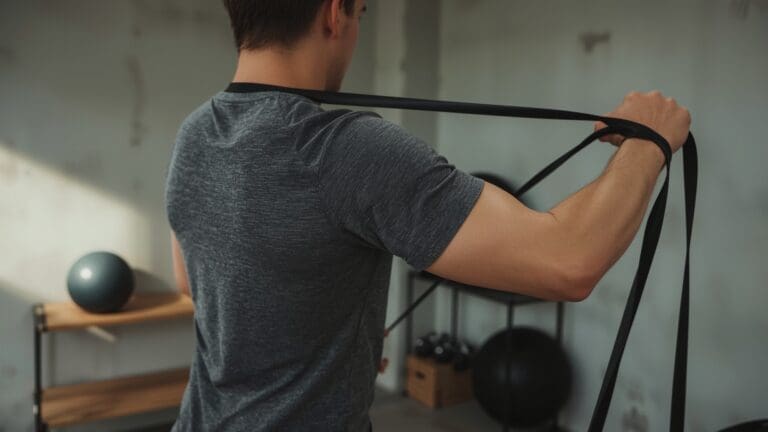
- Band pull-aparts: 2 sets × 15 reps
- Band shoulder dislocations: 2 sets × 10 reps
- Scapular push-ups: 2 sets × 10 reps
Then perform specific warm-up sets for your first lift. If your working sets on bench press are 185 lbs, do: empty bar × 10, 95 lbs × 8, 135 lbs × 5, 165 lbs × 3. This ramps your nervous system without creating fatigue.
Why Skipping the Warm-Up Is a Bad Idea
Cold muscles and stiff tendons are far more susceptible to strain and tears. The shoulder joint in particular has enormous range of motion but relatively little inherent stability. Warm-up sets prepare the rotator cuff, lubricate the joint capsule, and reinforce the movement pattern before heavy loads arrive.
What Common Mistakes Limit Upper Body Results?
Quick Answer: The biggest mistakes are neglecting back training, ego lifting with poor form, skipping rear delt and rotator cuff work, not tracking workouts, and changing routines too frequently. Consistency with a structured program beats random exercise selection every time.
Imbalanced Push-to-Pull Ratio
Many lifters do significantly more pushing (bench press, overhead press) than pulling (rows, pull-ups). This creates a strength imbalance between the chest/front delts and the back/rear delts. Over time, your shoulders round forward and your injury risk climbs.
Aim for a 1:1 push-to-pull ratio at minimum. Some coaches recommend 2:3 (more pulling than pushing) for lifters who sit at desks all day. If you bench 4 sets, row at least 4 sets.
Ego Lifting and Partial Reps
Using more weight than you can control through a full range of motion reduces muscle activation and increases joint stress. A half-rep bench press at 225 lbs builds less chest muscle than a full-range press at 185 lbs. Your muscles don’t read the number on the plate. They respond to tension through range of motion.
Program Hopping
Switching routines every 2 weeks gives you the novelty of new exercises but robs you of the adaptation that comes from progressive overload on consistent movements. Stick with a program for 8 to 12 weeks before making major changes. Track your lifts. If the numbers are going up, the program is working.
How Does Nutrition Support Upper Body Muscle Growth?
Quick Answer: Muscle growth requires a caloric surplus of 200 to 500 calories above maintenance, 1.6 to 2.2 grams of protein per kilogram of body weight daily, and adequate carbohydrates to fuel training. Without sufficient protein and calories, your upper body workouts won’t translate into visible muscle.
Protein Timing and Distribution
Spread your daily protein across 3 to 5 meals, with 25 to 40 grams per serving. Consuming 20 to 40 grams of protein within 2 hours after training supports muscle protein synthesis, though total daily intake matters more than exact timing.
For a 180 lb (82 kg) person aiming for muscle growth, daily protein intake should fall between 131 and 180 grams. Good sources include chicken breast (31g per 100g), Greek yogurt (10g per 100g), eggs (6g per egg), and whey protein powder (25g per scoop).
Carbohydrates for Performance
Carbs fuel high-intensity resistance training. Your muscles rely on glycogen (stored carbohydrates) during sets of 5 to 15 reps. Consuming 3 to 5 grams of carbohydrate per kilogram of body weight daily supports gym performance and recovery. Prioritize complex sources: oats, rice, potatoes, and fruit.
How Do You Prevent Shoulder Injuries During Upper Body Training?

Quick Answer: Prevent shoulder injuries by warming up thoroughly, maintaining a balanced push-to-pull ratio, performing face pulls and external rotation exercises regularly, using proper bench press form with retracted shoulder blades, and avoiding behind-the-neck pressing movements that place excessive stress on the shoulder capsule.
Shoulder-Friendly Exercise Swaps
If flat barbell bench press aggravates your shoulders, try a slight decline (10 to 15 degrees) or switch to a neutral-grip dumbbell press. These positions reduce stress on the anterior shoulder capsule while still heavily loading the chest.
Behind-the-neck presses and upright rows with a narrow grip place the shoulder in a vulnerable position (internal rotation under load). Replace these with front presses and wide-grip upright rows or cable lateral raises.
Rotator Cuff Strengthening
The rotator cuff is a group of four small muscles that stabilize the shoulder joint. Perform 2 to 3 sets of external rotations with a light band or cable (3 to 5 lbs) before every upper body session. This takes 3 minutes and dramatically reduces your risk of impingement and rotator cuff tears.
How Long Should an Upper Body Workout Take?
Quick Answer: A complete upper body workout takes 60 to 75 minutes including warm-up. This accounts for 5 to 7 exercises, 3 to 4 sets each, and appropriate rest periods. Sessions exceeding 90 minutes typically indicate excessive volume or too much rest between sets.
Time management at the gym comes down to rest periods. For heavy compounds (bench, rows, overhead press), rest 2 to 3 minutes for full neural recovery. For isolation movements, 60 to 90 seconds is sufficient. Using a timer on your phone keeps you honest.
Supersets (pairing opposing muscle groups back to back) cut session length without sacrificing quality. Pair bench press with barbell rows, or lateral raises with curls. You rest one muscle group while working the other.
What Equipment Do You Need for a Complete Upper Body Workout?
Quick Answer: At minimum, you need a flat/adjustable bench, barbell and plates, dumbbells, a cable machine, and a pull-up bar. Most commercial gyms have all of these. Adding resistance bands for warm-ups and face pulls rounds out a complete upper body tool kit.
Equipment Priority for Upper Body
| Equipment | Primary Use | Exercises Enabled | Priority Level |
|---|---|---|---|
| Barbell + Plates | Heavy compound loading | Bench press, overhead press, rows, curls | Essential |
| Adjustable Bench | Angle variation for pressing | Flat, incline, decline press; supported rows | Essential |
| Dumbbells (5–80 lbs) | Unilateral and isolation work | DB press, lateral raise, curls, flies | Essential |
| Cable Machine | Constant tension movements | Flies, pushdowns, face pulls, rows | Essential |
| Pull-Up Bar | Vertical pulling | Pull-ups, chin-ups, hanging exercises | Essential |
| Resistance Bands | Warm-up and activation | Band pull-aparts, shoulder dislocations, face pulls | Recommended |
Can You Build an Upper Body With Machines Only?
Quick Answer: Yes. Machines build muscle effectively because muscles respond to tension, not the tool creating it. Machine chest press, lat pulldown, shoulder press, pec deck, and cable work can create a full upper body stimulus. Machines are especially useful for beginners and those training around injuries.
The trade-off is that machines reduce stabilizer muscle activation. A machine chest press doesn’t challenge your core or smaller stabilizing muscles the way a barbell bench press does. For general hypertrophy (muscle size), this barely matters. For functional strength and athletic performance, free weights still have the edge.
A practical approach: use free weight compounds as your primary exercises and supplement with machines for isolation and higher-rep accessory work. This gives you the best of both worlds.
How Do You Track Progress on Upper Body Lifts?
Quick Answer: Track every workout by recording the exercise, weight, sets, and reps in a training log (app or notebook). Review your log every 4 weeks to ensure you’re adding reps, weight, or sets. If numbers are flat for more than 2 weeks, adjust your volume, intensity, or recovery.
Popular tracking apps include Strong, JEFIT, and Hevy. All let you log sets in real time, view historical performance, and track personal records. A simple notebook works just as well if you prefer analog methods.
Key metrics to watch over time: your 1-rep max estimates on bench press, overhead press, and barbell row. Also track total weekly volume (sets × reps × weight) per muscle group. If total volume trends upward over months, you’re growing.
Frequently Asked Questions
How many days per week should you train upper body?
Two upper body sessions per week is the minimum for optimal muscle growth. This frequency ensures each muscle group receives two growth stimuli with enough recovery time between sessions. An upper/lower split on 4 training days works best for most people.
Is it okay to train upper body two days in a row?
It’s not ideal. Muscles need 48 to 72 hours to recover and grow after a hard session. Training the same muscles on consecutive days increases fatigue and limits performance on the second session. Space your upper body workouts at least 2 days apart.
How long does it take to see upper body results from the gym?
Most beginners notice visible changes in 8 to 12 weeks of consistent training with proper nutrition. Strength gains appear earlier, often within the first 3 to 4 weeks. These initial improvements come from neural adaptations, meaning your brain learns to recruit muscle fibers more efficiently.
Should you do cardio on upper body days?
Light cardio for warm-up (5 to 10 minutes) is beneficial. However, performing intense cardio (running, cycling) immediately before resistance training reduces your lifting performance. If you need to do both, lift first and do cardio afterward. Alternatively, place cardio on separate days from your heavy upper body sessions.
What weight should a beginner start with on bench press?
Most beginner men can start with 65 to 95 lbs on the barbell bench press. Most beginner women can start with 35 to 55 lbs, or use dumbbells. The right starting weight lets you complete 3 sets of 10 reps with 2 to 3 reps left in the tank. If your form breaks down, the weight is too heavy.
Do you need protein shakes after an upper body workout?
No. Protein shakes are convenient but not necessary. Whole food protein sources (chicken, fish, eggs, dairy) work equally well. What matters is hitting your daily protein target of 1.6 to 2.2 grams per kilogram of body weight. A shake simply makes it easier to reach that number if your meals fall short.